Hooked On Photography
Nikkor Z 800mm f/6.3 VR S
Thoughts on my New Nikkor Z 800mm f/6.3 VR S
I recently decided to purchase the excellent Nikkor Z 800mm 1/6.3 VR S, this was a major investment at almost $7,500 CAD, so when presented with the opportunity to test the lens against my trusty Nikkor Z 180-600mm f/5.6-6.3 VR I took the challenge. To achieve a similar focal length I added the Z 1.4TC to the zoom lens.
The results were a little surprising, although I guess they shouldn’t have been. Here are my thoughts…
First, I feel the purchase of the Z 800mm is definitely justified by the results that I have seen so far, so I am happy and won’t be looking to sell it any time in the near future. My main focus in photography is wildlife and it’s often very difficult to get as close as you would like, so long lenses are an invaluable tool. I’m not so much into photographing birds in flight as seems very popular these days, but generally prefer large mammals that are often not safe to approach too closely, although I have sat a mere 15m away from a grizzly bear while it devoured a salmon right in front of us!
While I was visiting Squamish recently, I had several opportunities to photograph bald eagles that were feeding on the salmon spawning in the local rivers and estuary. On the last day I took some time to try both lenses side by side when I found an eagle that seemed quite settled in a tree and was not too active, I guess it had fed earlier and was inbetween meals. I added a 1.4 TC to the zoom lens in order to equalize the focal length of both lenses, this is the practice I used to use, thinking I was getting the best image that I could under such circumstances. The subject would be a similar size on the sensor.
The images produced by the Z 800mm were quite amazing compared to what I had been used to, so now I could finally see first hand the reason people spend such huge amounts of money on prime lenses, even though the new generation zoom lenses are truly amazing, they still can’t quite match a prime lens of the equivalent focal length. The first image in the series I took with the Z 800mm was spot on for sharpness and exposure, and even though I took several shots, the majority could easily be classed as keepers. I didn’t use a high shutter speed as the bird was fairly motionless and I had already established that the VR system was working extremely well, especially for static subjects.
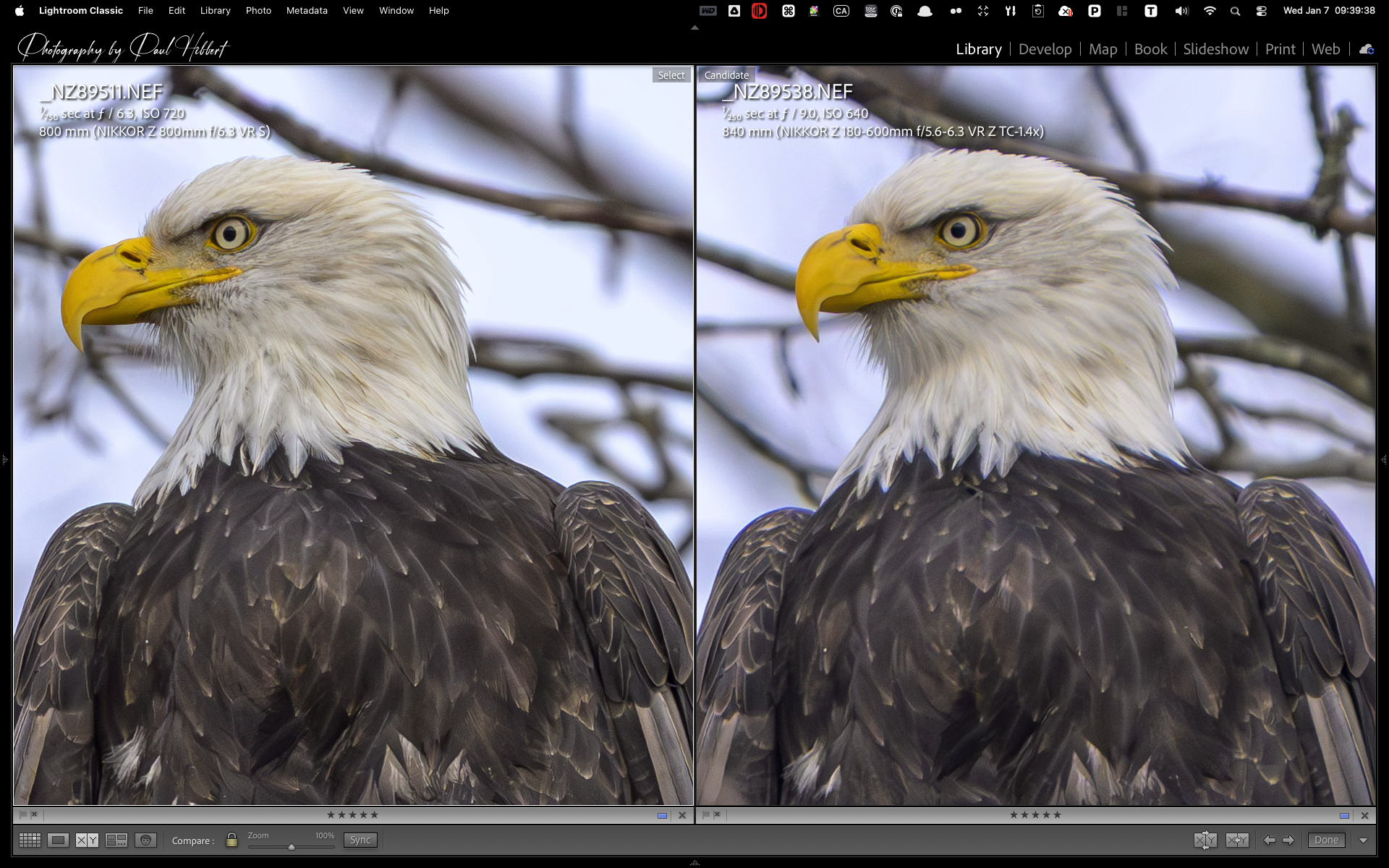
The images shot with the Z 180-600mm were quite pleasing but definitely exhibited a lower image quality. Notable areas was the lack of acuity in the image where fine detail was so apparent in the Z 800mm images, especially the bird's white feathers. The overall appearance of sharpness was good, but the lens combinaltion just couldn’t quite compete with the Z 800. This was probably more noticeable because of the subject matter, the fine detail in the bird’s feathers was the major challenge, even though they appeared sharp with the zoom lens, there just wasn't the same level of information.
The Z 180-600mm and 1.4TC combo also suffered some more noticeable chromatic aberration, this appears in several areas including close the the centre of the lens which did surprise me. This is only a minor annoyance as it can be edited out quite easily in LR, but it does add an extra editing step.
One area where the Z 180-600mm excels over the Z 800mm is in the bokeh. Because the Z 800mm is a Phase Fresnel lens some out of focus detail isn’t too appealing, especially where there are small out of focus details with strong contrast, such as small branches against the brighter sky, I can live with this as the subject is way more important to me. Unfortunately this doesn't show too much in the image below.
The eagle eyed viewer will notice that the image from the Z 180-600mm is taken at a much lower shutter speed, the reason for that is because this was the best of a full series of images and the one chosen was sharper than all of the images taken at higher speeds.
The number of keepers from the Z 800mm was far higher than the Z 180-600mm and 1.4TC combo, I haven't pinpointed exactly why this is, but currently I conclude that it's just the way better quality image produced by the prime lens as opposed to a zoom with a tele-converter. Having said that, I would like to try experimenting with the Z 180-600mm and using DX mode instead of using the TC, at least then I would be comparing the results from the native glass and not through some auxiliary component.
I'm really looking forward to my next wildlife challenge, especially if I get to use the Z 800mm again.
To see the image below in full screen, right click on it and choose "Open in new window", you should then be able to view at 100% and see the differences more clearly.